BioRevolution #17 - Biosensors in Healthcare
Today, we step into the silicon-based world to take back what once belonged to us.
When we look from a broader view, it becomes clear that silicon technologies are not purely human inventions. They are reflections of nature’s own designs. Throughout history, engineers and designers have looked to living systems for inspiration. The anatomy of birds, for example, guided the evolution of flight. And that is just one of thousands of examples.

Our topic is biosensors. To start, think of the sensors you encounter in daily life. What comes to mind first? Automatic doors? Parking systems? Smoke alarms? Why not think first about your own body?
We do not need to go far to find the connection. Think about the traditional five senses that shape how we experience the world. Our eyes detect light, our ears catch sound waves, and our nose recognizes chemicals in the air. The tongue identifies the chemical makeup of food, while the skin feels pressure and temperature. Every moment of perception begins with sensing, and our bodies have evolved a sophisticated network for it.
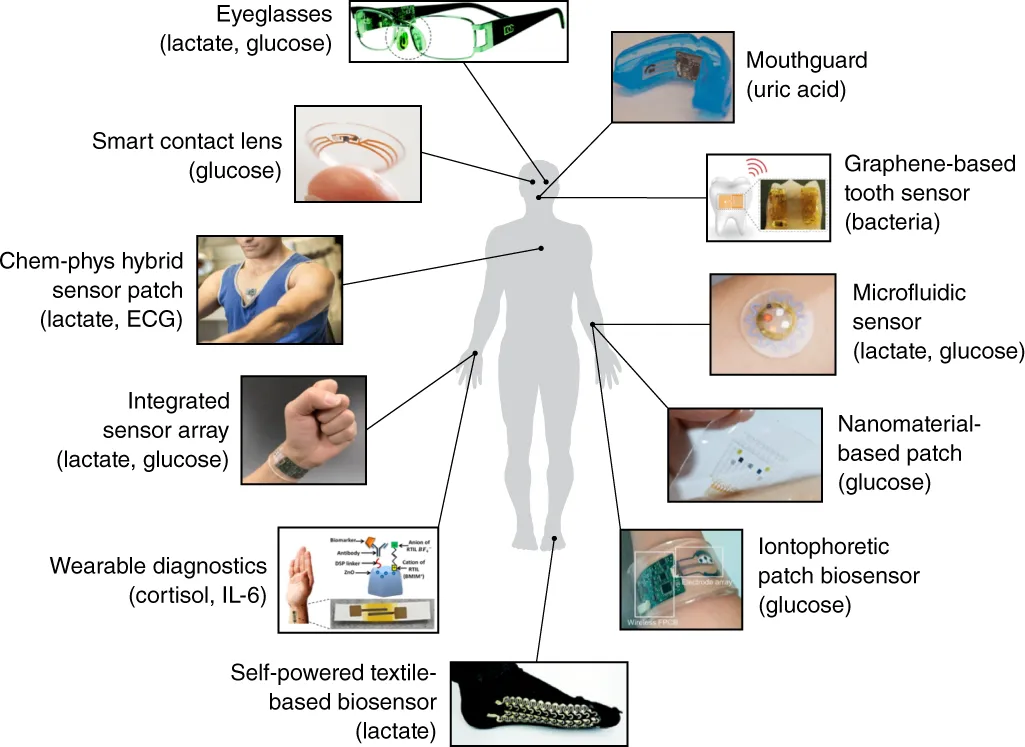
Most of us have already encountered biosensors without realizing it. But the story of biosensors goes far beyond consumer wearables. They are reshaping medicine and accelerating research in laboratories, creating new opportunities for healthcare innovation and biotech investment.
Today, we enter that space again, the meeting point of biology and technology.
Welcome to the world of biosensors!
BioRevolution #17 - Biosensors in Healthcare issue is supported by Capital Cell, which is Europe’s leading investment platform specialized in biotech and health startups, connecting groundbreaking science with forward-thinking investors. This article is available in properly written 🇫🇷 French and 🇪🇸 Spanish on the Capital Cell blog.
Health Tech Forward is an annual two-day conference taking place on December 3-4, 2025, in Barcelona. With 1000+ attendees and a lineup of global digital health entrepreneurs, medical practitioners, venture capitalists, and government leaders, the conference will explore the evolving trends shaping the future of digital health.
Find more details about the event at healthtechforward.com
🚀 You can use our code PARTNER20 for a ticket discount.
Scientific Perspective
Biosensors detect a specific substance, like a molecule or virus, and turn that detection into an electrical signal we can read. This makes them incredibly useful for medicine. At their heart, biosensors are built on two main parts: a biological recognition element, called a bioreceptor, and a transducer, which converts the biological reaction into a measurable signal.
The bioreceptor is the part of the sensor that actually recognizes the target substance, also known as the analyte. It can be an enzyme, antibody, nucleic acid, cell, or even a piece of tissue. When the analyte binds to the bioreceptor, a change occurs in the system. This change could be a shift in heat, pH, mass, light, or electrical charge. Some bioreceptors, called catalytic receptors, catalytic receptors, are used for continuous monitoring, such as tracking blood sugar levels. Others, called non-catalytic receptors, detect substances that occur in very small amounts and are usually single-use, like antibodies in a pregnancy test. The bioreceptor must be highly specific and stable, ensuring that it accurately senses only the intended analyte.
The transducer is the part that translates the biological event into a measurable signal. Essentially, it converts one form of energy into another. When the bioreceptor interacts with the analyte, a small physical or chemical change occurs. The transducer detects this change and turns it into an electrical signal, such as a shift in voltage, current, or frequency. For instance, in a glucose biosensor, the enzyme glucose oxidase reacts with glucose to produce gluconic acid. This changes the pH of the solution, and the transducer detects the shift, converting it into a readable electrical signal. Transducers can work using optical, electrochemical or piezoelectric techniques, depending on the design and intended application. (…)
Once the transducer generates a signal, it is often weak and mixed with background noise. Electronics inside the biosensor amplify and filter the signal, making it easier to read. The data is then converted into a digital format, processed by a microprocessor, and finally displayed on a screen or sent to a smart device. This process ensures that the biological event, invisible to the naked eye, can be measured and interpreted in real time. Modern biosensors can even transmit data to smartphones or cloud systems, allowing continuous monitoring of health or environmental conditions.
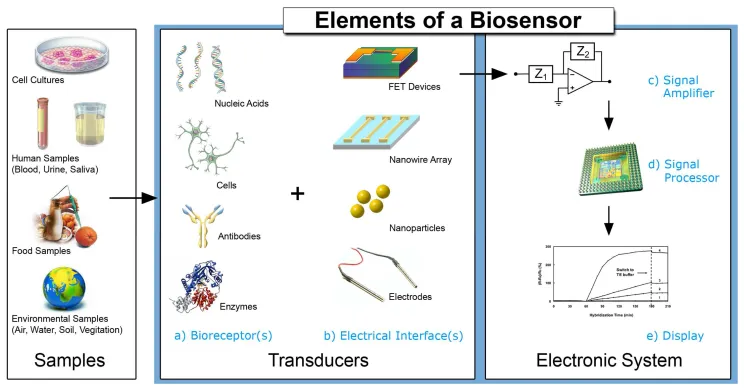
The working mechanism of a biosensor can be understood as a three-step process. First, the bioreceptor recognizes and binds to the analyte, creating the biological event (for instance, an antibody in the sensor might capture a virus protein in a sample). Second, the transducer detects the resulting physical or chemical change and converts it into an electrical signal (for example, an electrode might experience a change in voltage, or a small optical chip might change how it reflects light). Third, the electronics process, amplify and display the result in a readable form. All of this can happen in a matter of seconds or minutes. While the details may differ slightly depending on the type of biosensor, this sequence of recognition, transduction, and signal processing is the same across most devices. (…)
Biosensors differ from other analytical tools. A bioanalytical system usually requires extra steps, such as adding reagents, while a single-use biosensor is disposable and measures only once. True biosensors combine a bioreceptor and a transducer to continuously provide real-time measurements. The first biosensor was an enzyme electrode for measuring glucose, which later evolved into the blood glucose meters used by millions of diabetics today. Since then, biosensors have expanded into detecting viruses, toxins, pollutants, and even biomarkers for personalized medicine.
In short, biosensors bring the precision of nature into human technology. They take an invisible biological interaction and translate it into something we can measure, understand, and act on. Biosensors are quietly transforming our ability to see and respond to the world at a microscopic scale. (…)
Market Perspective
Biosensors have become one of the most dynamic areas of modern technology. The global biosensors market is projected to grow from USD 34.51 billion in 2025 to USD 54.37 billion by 2030, at a CAGR of 9.5%. The key driver is the use of biosensors to monitor glucose levels in people with diabetes, and wearable biosensors are expected to grow the fastest. The main challenge is regulation: long certification and approval cycles still slow the path to market.
-MarketsandMarkets, Biosensors Market Report 2025-2030-
Startup Ecosystem
Biosensor startups are growing especially in the US (Boston and San Diego) and Europe (Paris and London), while Asia-Pacific is expected to be the fastest-growing region for the market. Here are some examples:
A Southborough, Massachusetts based company, founded in 2010, is developing rapid point-of-care and in-vitro diagnostic products on its proprietary nanowire biosensor platform. Its system uses an array of highly sensitive nano-sensors whose surfaces are coated with proteins that bind to specific target biomarkers. When a biomarker binds, it changes the electrical signal of the nanowire, so the system can measure results in minutes from a variety of sample types. It has raised a total of USD 30.1 million over 6 funding rounds, and its largest round so far was an USD 18 million Series C in July 2020.
A Boston based startup, founded in 2015, has built a sweat patch that gives athletes, soldiers and laborers real-time hydration data. The patch analyzes sweat composition every second and tracks fluid and electrolyte losses, then sends live notifications through a clip-on pod to an app or smartwatch. In June 2026 it launched a dashboard that turns real-time hydration data into three risk scores: injury, cognitive and performance risk. In September 2026, it closed a USD 10 million Series A, bringing its total funding to USD 17 million, with participation from 23andMe founder Anne Wojcicki and the owners of several major US sports teams.
A Paris based startup, founded in 2021, is transforming kidney care with a wearable patch for home potassium monitoring. People with chronic kidney disease often develop hyperkalemia, a condition where potassium levels become too high, which can lead to fatal heart rhythm problems. Its patch measures potassium continuously, much like the glucose sensors used by people with diabetes, and connects to a remote monitoring platform where physicians can follow patients and adjust treatments. Chronic kidney disease affects 850 million people worldwide, and 37% of them experience hyperkalemia. It raised €2.3 million in pre-seed funding to take its technology through clinical trials ahead of FDA approval.
A San Diego based startup has developed the first needle-free continuous glucose monitor on the US market. Its patch uses an array of tiny electrochemical sensors that measure glucose just beneath the skin’s surface, sitting shallower than traditional sensor filaments, which reduces insertion pain. Instead of requiring a smartphone, the patch shows color-coded glucose ranges directly on the device. It received FDA De Novo classification in September 2025, which created a new device category. It raised a USD 100 million Series C in April 2025, led by Alpha Wave Ventures, with Japan’s Taisho Pharmaceutical among its investors, bringing its total funding to around USD 300 million. It is also testing its platform beyond glucose: one study used a DNA-based sensor to track an amino acid linked to muscle loss during GLP-1 weight-loss therapy.
A UK based startup has built a multi-molecule biosensor platform that detects biomarkers just beneath the skin in real time. Its first product is a continuous glucose monitor, and early clinical data showed accurate glucose readings for up to 10 days of continuous wear. Because the platform can detect more than one molecule, it aims to expand into other biomarkers in the future. It raised a USD 19 million Series A in 2025.
If you are interested in biosensors in healthcare and would like to learn more about the startups mentioned here, or simply exchange ideas about this field, feel free to reach out to me. I’d be happy to share more details and help you find the right connections.
The information in this Market section was last updated in September 2026. Market figures, funding amounts and company details may have changed after this date.
🪄 My TEDx Talk on BioRevolution is Live!
(English subtitles are available)
Future Perspective
We are entering a new era of personalized medicine, where biosensors and digital technologies work together. If you have read my article on the Digital Twins in Healthcare you already know how these ideas connect. Imagine a future where your Digital Twin (a virtual version of your body) works alongside your biosensors to monitor your health in real time. Your tablet could warn you when your body needs more water or when your stress levels get too high. It could even suggest lifestyle changes before you need medication. This combination of biosensors and Digital Twins can help reduce unnecessary medication use and prevent waste, allowing doctors to prescribe exactly the dosage your body needs.
This technology can also transform preventive medicine. Instead of waiting for symptoms to appear, biosensors can continuously track your body’s signals and detect early warning signs of disease. Combined with genetic analysis, they can reveal your personal health risks and guide you to take action before a condition starts. Imagine wearing or implanting biosensors designed according to your genetic profile, silently tracking your health and notifying you of the earliest changes. Doctors could intervene at the very first hint of a problem, long before traditional symptoms emerge.
In clinical research, biosensors can make an equally profound impact. During drug trials, unexpected results sometimes appear, not because of the drug itself but because of unrelated factors that are difficult to detect. Continuous data from biosensors can help researchers follow every moment of a participant’s response, providing real-time insights. This means potential side effects can be identified earlier, and promising treatments can move forward faster and more safely.
The future of biosensors goes beyond innovation in materials or measurement. It is the beginning of a new partnership between human biology and digital intelligence. As these tools evolve, they will not only diagnose diseases but help prevent them, guiding us toward a healthier, more informed future.
🤨 Wait… Did you miss my article on Nanorobots in Healthcare?
📰 SUBSCRIBE TO MY LINKEDIN NEWSLETTER
If you liked this newsletter article, I hope you’ll consider being a regular subscriber. 🙏
Just scroll up to the very top and click that SUBSCRIBE button.
Originally published on LinkedIn.