BioRevolution #6 - Digital Twins in Healthcare
In each newsletter issue, I explore a different topic that is revolutionizing the world of biotechnology. As someone passionate about technology, these are not technologies I have heard of for the first time, but as I delve deeper into them while writing, my admiration for these technologies increases exponentially. The subject of this issue is “Digital Twin in Healthcare”. Immersing myself in articles and videos, I was constantly pondering, “What’s next?” I reached incredibly exciting points with this question. Please close your eyes and imagine that you have a twin, a digital twin. Thanks to this digital twin, you can connect to your body from your tablet and understand what is going well and what is going wrong.
You can find the craziness that goes through my mind under the subheading “Future Perspective”. Before that, you are invited to examine what the concept of “Digital Twin in Health” is under the title of Scientific Perspective and to read the title of Market Perspective to better understand who is doing what and what they will do while we are dreaming. If you and your twin are ready, let’s get started!
Scientific Perspective
Digital twins in healthcare are a revolutionary concept that brings the virtual and physical worlds closer together. It merges the virtual with the physical, offering advanced models that mirror patients or their organs. These models blend real-time and historical health data, processed by complex algorithms, to mimic real-life health scenarios. This blend helps doctors and researchers understand diseases better, try out treatments safely, and make medical research more accurate.
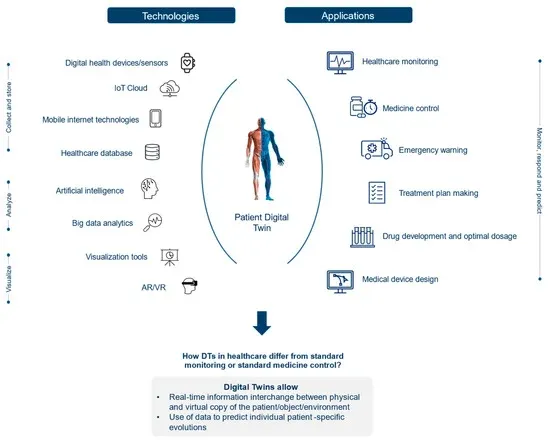
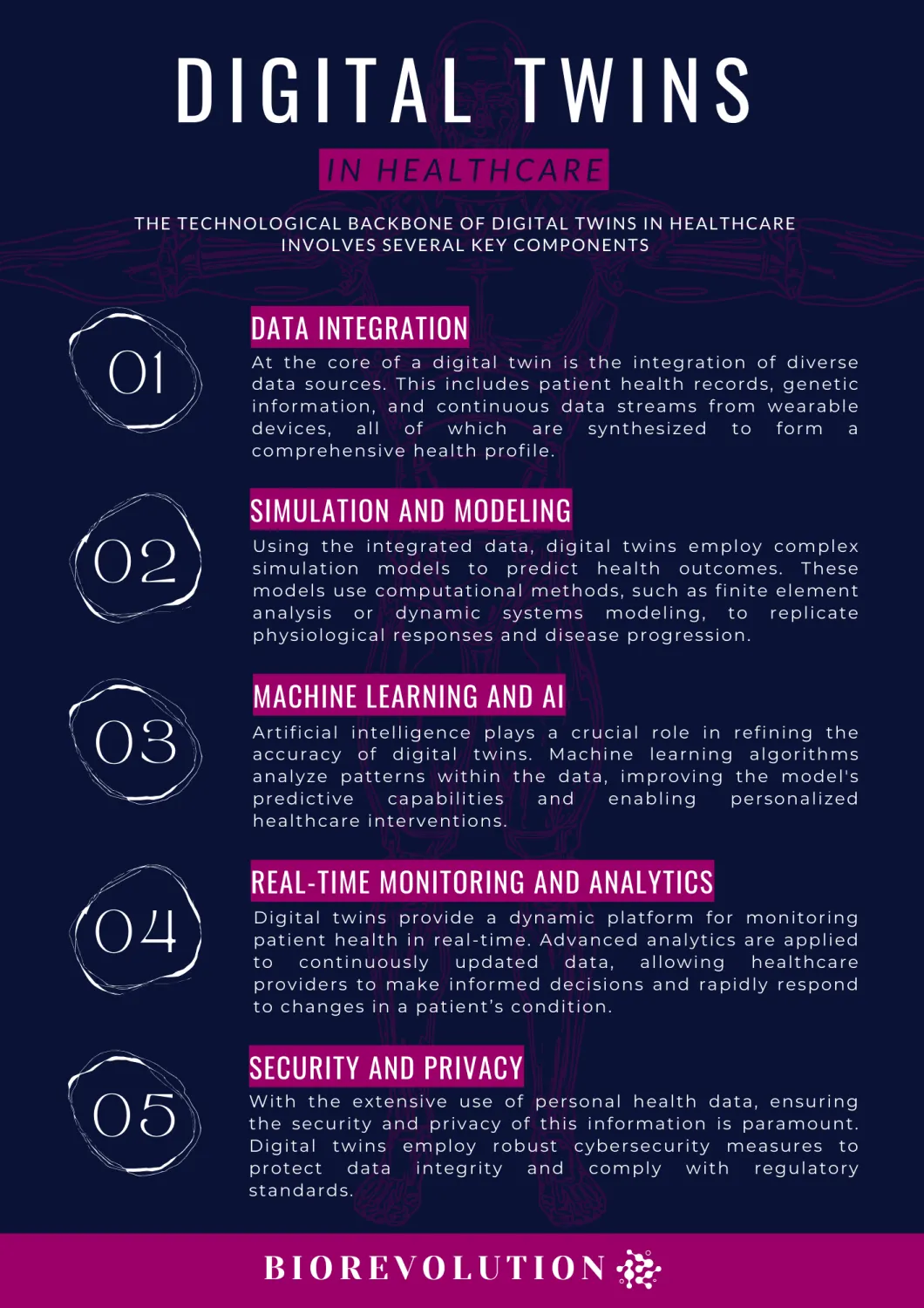
Creating a digital twin involves pulling together different kinds of health data, including patient records, biometric information, physical and mental health records, real-time physiological metrics, and medical images, to build a complete health picture. This digital model helps simulate how a patient might react to a treatment or a disease, offering a safe space for testing and research.
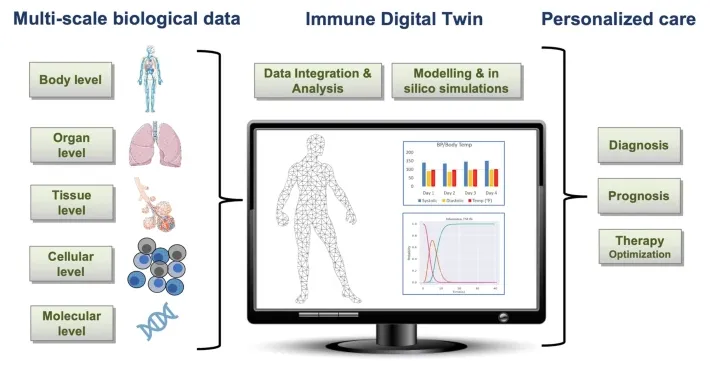
↪️(At each relevant physiological scale, known biology and relevant mechanisms are characterized through data collection that informs one or more computational models. The models at the individual scales are then integrated into a comprehensive multiscale base model. In the second step, this base model is personalized by parameterizing it with data collected from an individual patient. The resulting digital twin can then be used for clinical decision-making for this patient.)
Developing a digital twin is detailed work. It starts with gathering and combining health information to build a model that closely matches the patient’s real condition. The accuracy of this model gets better over time by adding new data and refining the model with powerful software.
In the world of medicine, digital twins have a lot of promise. They can help drug companies predict how different people might react to their medicines, making the process of developing new drugs quicker and cheaper. They can also make clinical trials more reliable by forecasting how patients might respond to treatments, reducing the risk of unexpected side effects.
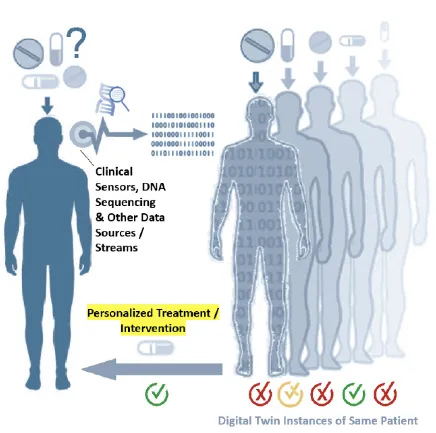
↪️(Digital twin instances of the same person or patient can be used for in silico testing and comparison of different treatment or preventive intervention possibilities to find out which option will work best for that particular individual. Note the data flow from clinical sensors, DNA sequencing, and other data sources and streams to the digital domain.)
Digital twins, enhanced by artificial intelligence, offer ongoing insights into health conditions, allowing for healthcare that’s tailored to individual needs. This can lead to better health outcomes and improved life quality. However, creating and using digital twins also presents challenges, especially in ensuring data accuracy and maintaining privacy. To make digital twins as effective as possible, it’s essential to use precise data and the right technology to spot and fix errors.
🪄Video Suggestion
Digital twin of a patient: A look into the future - Siemens Healthineers
Market Perspective
The global healthcare digital twins market was valued at USD 902.6 million in 2024. It is projected to grow from USD 1,409.0 million in 2026 to USD 3,549.5 million by 2030, a CAGR of 25.9%. North America dominated the market with a 46.8% revenue share in 2024. The software segment led the market with a 78.8% revenue share and is expected to grow the fastest.
-Grand View Research, Healthcare Digital Twins Market Report 2025-2030-
Startup Ecosystem
Healthcare digital twin startups are growing especially in the US (California) and Europe, with Munich and Barcelona standing out as strong hubs. Here are some examples:
A Munich based startup, founded in 2019, lets medical device developers test their products on virtual patients. It builds digital patient models from real clinical data that reflect anatomical variability, demographic diversity and pathological conditions, so a device can be tested on many different virtual bodies before it reaches a real one. This kind of in silico testing can also replace some animal testing in the approval process. Accenture Ventures has invested in the company. In December 2025 it closed a Series A of more than €5 million, led by a crowdinvesting platform, with around 1,950 individual investors and Bayern Kapital participating. It plans to use the funding for international growth and to get regulators to accept virtual studies as part of real approval processes.
A Barcelona based company, founded in 2011 with offices in Cambridge, Massachusetts, develops non-invasive brain stimulation technology. It coordinated an EU-funded project to build personalized hybrid brain models that combine the physics of electromagnetism with each patient’s physiological data. These “brain twins” help predict how an individual brain will respond to electrical stimulation, with the goal of personalizing treatment for Alzheimer’s patients. The company raised a $17.5 million Series A led by Morningside Ventures, its first private capital after 10 years of operating on research grants and device sales. The funds support a Phase 3 trial of its stimulation headcap for epilepsy patients who don’t respond to medication.
A California based startup, founded in 2015, builds a whole-body scanner designed to create a digital twin of each person. Its scanner uses a method called tensor field mapping, which models the machine’s own imperfections and the environment so that repeated scans of the same person give comparable, quantitative results over time. A single scan provides more than 3,000 anatomical measurements, with no radiation and no breath holds. The company raised more than $80 million by 2021, with investors including Andreessen Horowitz and Kaiser Foundation Hospitals. In 2024, it raised a further $27 million, joined by Telus Global Ventures, Khosla Ventures and Founders Fund.
A Barcelona based startup, founded in 2018 as a spin-off from the Barcelona Supercomputing Center, creates populations of virtual humans. It runs multi-physics simulations of the cardiovascular and respiratory systems on supercomputers, so drugs and medical devices can be tested on thousands of virtual patients before clinical trials. It serves pharma, medtech companies and CROs from discovery through clinical phases. It has raised $3.46 million, with investors including the European Innovation Council and Oracle.
A San Francisco based startup, founded in 2017, uses AI to create digital twins of clinical trial participants. Before each participant is randomized, the model generates a digital twin that forecasts how that person’s health would change on placebo. This means trials can run with smaller control groups, so more patients receive the experimental treatment. Its models are trained on data from thousands of clinical trials and observational studies covering about a million patients across around 30 indications. The European Medicines Agency has qualified its core methodology, the first AI methodology in clinical trials to receive this recognition. It has raised more than $130 million in total, including a $50 million Series C led by Altimeter Capital.
If you are interested in digital twins in healthcare and would like to learn more about the startups mentioned here, or discover other promising teams in this space, feel free to reach out to me. I’d be happy to share more details and help you find the right connections.
The information in this Market section was last updated in September 2026. Market figures, funding amounts and company details may have changed after this date.
🪄Video Suggestion
The Human Digital Twin - Barcelona Supercomputing Center
Future Perspective
- Looking to the future, the scope of digital twins in healthcare is expected to broaden, driven by advancements in big data, the Internet of Things (IoT), artificial intelligence (AI), and machine learning. These technologies will further refine the accuracy and applicability of digital twins, enabling more personalized and effective healthcare solutions. As this field evolves, digital twins are poised to become a cornerstone of precision medicine, revolutionizing the way healthcare is delivered and experienced.
- The use of digital twins in health can enable individuals to become more effective in personal health management. Imagine a world where you can get detailed information about your health from a screen on your tablet. At some point beyond its current state, it may give you a warning that you should drink more water when your body needs water. We can expect an increase in “conscious” drug consumption with that. The digital twin application can solve problems that can be solved without using medication, thanks to the on-site advice it gives.
- When planning your medication, your doctor can make more accurate decisions by estimating the amount of medication you will need. We can switch from buying boxed medicine to buying single medicine, which is an important step in medicine waste. By talking about “personalized medicine”, we are addressing personalized treatments, and we are also taking an important step against the use of incorrect medications.
- I would like to take you one step further with the perspective provided by the nutrigenomics course I am taking this semester. I predict that by scanning the barcodes on food into the digital twin application on our phone, we can see which food we should or should not eat and how much of which food we eat will be positive for our health.
- I would like to mention that it will be groundbreaking in surgery planning and drug discovery. We can also observe our body moment by moment, thanks to biosensors developed and placed specifically for our chronic problems or genetically potential diseases. Nowadays, when we talk about the importance of preventive medicine, we can talk about the benefits of digital twins.
📰 SUBSCRIBE TO MY LINKEDIN NEWSLETTER
If you liked this newsletter article, I hope you’ll consider being a regular subscriber. 🙏
Just scroll up to the very top and click that SUBSCRIBE button.
We will be together again in two weeks with our new topic. If you guess the next topic, write it in the comments.
See you beyond Digital Twins :)
Originally published on LinkedIn.