BioRevolution #15 - Nanorobots in Healthcare
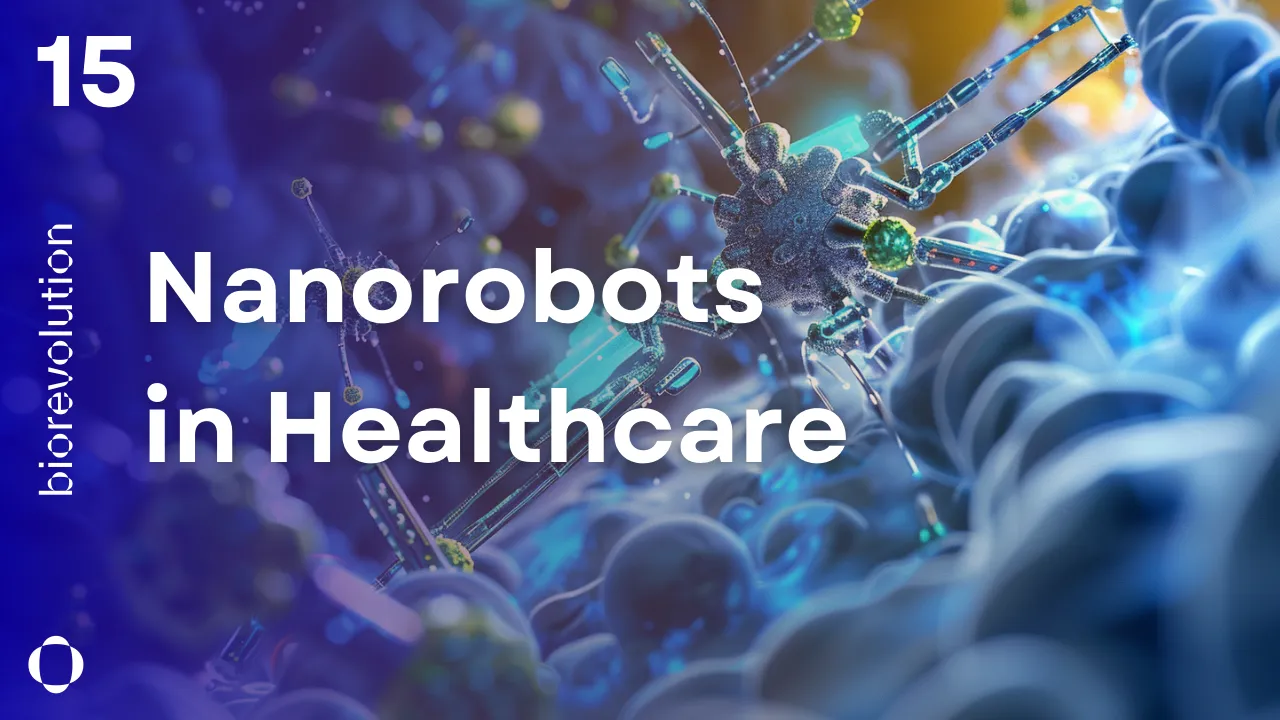
Sometimes, the most astonishing revolutions aren’t loud or towering; they’re invisible. As humanoid robots dominate headlines and social media feeds, there’s an equally profound shift happening at a scale so small, it defies imagination.
To wrap my head around the size we’re talking about, I asked my AI co-pilot ChatGPT to help me visualize it. If a 1-nanometer sphere were scaled up to the size of a grain of salt, then that grain of salt would be as massive as Arizona’s famous Meteor (Barringer) Crater. Yes, that big. Mind officially blown.

But beyond the metaphor lies a very real scientific frontier: How do we build something smaller than a human cell, yet intelligent enough to act inside our bodies? The answers are emerging slowly, pulled together from the edges of quantum physics, synthetic biology, nanochemistry, and bioengineering.
If this is your first time hearing about nanorobots, you’re not alone. Most people haven’t caught up yet. But those working in this field are already dreaming far ahead—targeted drug delivery, self-repairing tissues, even intracellular diagnostics. So today, we zoom in—way in—and begin exploring a world you’ll probably never see with your eyes, but may one day rely on to save your life.
Welcome to the hidden universe of nanorobots!
Scientific Perspective
Nanorobotics is an emerging field where robotics and nanotechnology converge, blending engineering, materials science, and even biology to create machines the size of molecules. In this interdisciplinary domain, researchers design nanorobots, machines typically 1–1000 nanometers across, that can operate with extreme precision in environments where ordinary machines cannot. For scale, nanorobots are comparable to or smaller than biological cells, meaning they can potentially swim through the bloodstream, crawl along DNA, or maneuver among nanoparticles. Because they exploit unique nanoscale physics and chemistry (such as quantum effects and surface forces), these tiny robots could revolutionize medicine, manufacturing, environmental monitoring, and more. At its core, nanorobotics aims to manipulate matter at the molecular level. The vision is that fleets of nanobots could navigate complex environments (inside the body or in the lab) and execute tasks with unprecedented accuracy. By combining tools from robotics, nanofabrication and bioengineering, scientists hope to build machines that can assemble, inspect, or repair structures atom by atom or molecule by molecule. In principle, this could enable breakthroughs from programmable drug carriers to bottom-up manufacturing of novel materials. […]
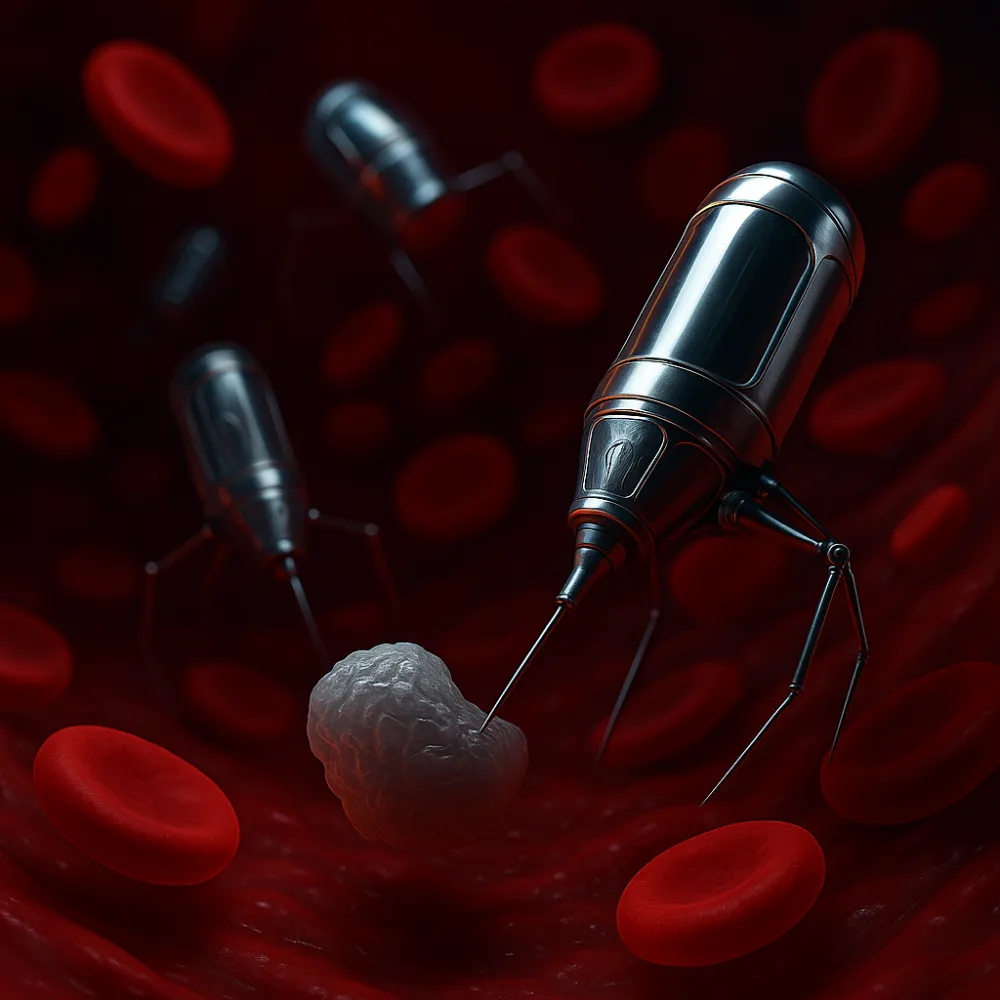
To achieve movement, scientists have created a variety of micromotors. Some teams use tiny helical coils that spin under rotating magnetic fields, mimicking bacterial flagella. Others use light-activated materials, pH-sensitive polymers or enzymatic reactions to move when triggered. These micromotors often exploit self-assembly or nano-patterning for fabrication (for instance, rolling up thin films or coating beads). Despite the diversity of approaches, a common goal is the same: convert some energy source (chemical, magnetic, acoustic, or even biological) into continuous thrust that can be controlled to direct the nanobot where it needs to go.
Beyond purely synthetic motors, biohybrid strategies incorporate living cells or biomolecules into nanorobots. The idea is to use nature’s nanomachines as components. For instance, bacteria like E. coli or Salmonella have evolved efficient flagella-driven swimming. Researchers have attached magnetic microstructures to these bacteria so that an external magnetic field can guide the organism’s built-in propulsion. In effect, the bacteria serve as an engine and sensor, carrying a tiny payload or device to a target. Similarly, microscale swimmers have been built using sperm cells as motors. Additionally, cell membrane-coating techniques provide nanorobots with enhanced biocompatibility, enabling them to evade immune responses and function effectively within living organisms. […]
Imagine taping a tiny payload to a bacterium and letting physics take the wheel, that’s the level of creativity happening here.
The most immediate applications of nanorobotics are in medicine. In principle, nanobots could roam inside the body performing tasks at cellular resolution. For example, they might be injected into the bloodstream to deliver drugs directly to diseased cells, target cancer cells, or perform minimally invasive surgeries. By homing in on a target (say, a tumor) and releasing a drug only there, a nanobot could greatly increase efficacy while sparing healthy tissue. Targeted therapy like this would reduce doses and side effects, because much less drug is needed when it is delivered exactly where it is needed. Beyond drug delivery, nanorobots could serve as tiny surgeons or diagnostics. They might clear blockages in capillaries, stitch or repair cells, or biopsy tissue too small to reach with traditional tools. Sensors on nanobots could detect chemical signals of disease early on.
Ultimately, nanorobotics represents more than just a miniaturization of machines. It is a redefinition of robotics itself, guided by principles of biology, quantum physics, and material science. As researchers continue to unlock the secrets of nanoscale dynamics and develop bioinspired and biointegrated designs, nanorobots could soon become indispensable tools for exploring and transforming the world at the smallest scales. […]
🪄Video Suggestion
How Nano Robots Will Change Medicine Forever by Dr Ben Miles, Ph.D.
Market Perspective
The global nanorobots in healthcare market was estimated at USD 7.8 billion in 2024 and is expected to reach USD 11.0 billion by 2030, growing at a CAGR of 5.9%. Bio-nanorobotics is one of the fastest-growing segments, with an expected CAGR of 8.3%. Asia is becoming an important part of this story: China’s market is forecast to reach USD 1.8 billion by 2030, and Japan and Canada are also among the notable growth markets.
-Global Industry Analysts, Nanorobots in Healthcare Global Market Report 2024-2030-
Startup Ecosystem
Nanorobotics startups are growing in the US, France, Türkiye, and most of them are spin-offs from strong university labs. Truly nanoscale robots are still mostly at an early stage, so the field also includes microrobots that are larger but already closer to clinical use. Here are some examples:
A US based startup, founded in 2021, engineers DNA-based nanorobots that can operate with molecular-level precision inside the human body. Its core technology uses logic-gated DNA nanostructures, tiny programmable machines built by folding DNA into precise shapes, a technique known as DNA origami. These machines can recognize specific biological signals and release their therapeutic cargo only when they reach the targeted disease site, which reduces toxicity in the rest of the body. Its main applications are cancer treatment, gene therapy and diagnostics. In January 2024, it closed a pre-seed round, secured licensing rights for DNA origami technologies from a US university and launched its own therapeutic pipeline alongside a biopharma partner program.
A Bengaluru based startup, founded in 2020 and incubated at the Indian Institute of Science, is bringing nanorobots to dental care. Tooth sensitivity is caused by tiny open channels inside the teeth, and the startup uses magnetically guided nanorobots that travel deep into these channels and build durable mineral seals inside them. This could give long-lasting relief in a single minimally invasive treatment, instead of daily use of special toothpastes. Tooth sensitivity affects over 2 billion people worldwide and represents a USD 6 billion market. It raised a USD 1.2 million seed round led by pi Ventures, and in 2025 its team received the IADR Innovation in Oral Care Award, the first time a team from the Indian subcontinent received this global recognition.
An Istanbul based startup, founded in 2015 as a spin-off from Boğaziçi University, develops smart nanomedicines for targeted chemotherapy (not nanorobots, but nanoscale drug carriers that share the same goal of precise delivery). Traditional chemotherapy harms both cancer cells and healthy dividing cells, which causes serious side effects. Its proprietary platform uses biodegradable nanocarriers that deliver chemotherapy drugs directly to tumor cells, making treatment more effective while reducing side effects. It developed Türkiye’s first new drug candidate brought from bench to clinic within the country, and its lead candidate is in a Phase I clinical trial for non-small cell lung cancer. Its platform is protected by patents covering 58 countries. It raised a USD 12 million Series A led by GEN, with participation from OneLife and Eczacıbaşı Momentum, and it expands globally through a subsidiary founded in Switzerland.
If you are interested in nanorobots in healthcare and would like to learn more about the startups mentioned here, or simply exchange ideas about this field, feel free to reach out to me. I’d be happy to share more details and help you find the right connections.
The information in this Market section was last updated in September 2026. Market figures, funding amounts and company details may have changed after this date.
🪄 Bonus Insight
Nanorobots in healthcare today are where CRISPR was in 2012; understood in theory, proven in labs, just waiting for breakthroughs to unlock multi-billion-dollar potential.
This is a market in its birth phase, with massive upside, but still years from real commercial use. You’re not late, you’re early. Very early. Because you are a BioRevolution reader :)
Future Perspective
Bio-Nanopollution
Today, low Earth orbit is crowded with more than 100 million pieces of debris, everything from defunct satellites to screws drifting at 28,000 km/h. What began as a triumph of engineering quickly became a crisis of cleanup. […] And we didn’t see it coming fast enough.
Now, we’re standing at a similar threshold with nanorobotics. The promise of deploying molecular machines inside the human body is real, but so is the risk of accumulation, persistence, and loss of control. What happens if we saturate the body with these tools, without a plan for their removal, degradation, or decay?
Here are the questions we should be asking today, not after the fact:
-> Could nanorobots accumulate inside the body over time, like space debris?
Yes. Especially if they’re designed to persist, operate over long durations, or lack self-destruct protocols. In a chronic treatment scenario, long-term buildup could become an issue.
-> Is there a risk that nanorobots left behind could cause inflammation or interfere with future diagnostics?
Potentially. Foreign particles, even if inactive, can trigger immune responses or mislead diagnostic imaging. We already see this with some nanoparticles used in imaging agents or drug delivery.
-> What mechanisms exist (or are being researched) to retrieve or biodegrade nanorobots after use?
Some research points to biodegradable nanomaterials (like DNA origami, hydrogel-based bots, or magnesium-zinc alloys), but controlled retrieval is still largely hypothetical. No clinical standard exists yet.
-> Could this lead to a systemic pollution problem, not just individual risk, but environmental spillover?
If nanorobots are excreted or flushed into water systems, it’s plausible. This is where bio-nanopollution extends beyond the body into ecosystems, especially if bots are engineered for long-term stability.
-> Are there lessons from space debris policies that we can apply here?
Absolutely. Concepts like “end-of-life protocols,” “active removal,” and “international accountability” are directly translatable. But in biotech, regulation always lags innovation. That’s our window.
We’ve asked our questions and done our best to answer them, yes. But what truly excites me is the thought that, one day, my grandchildren might ask, “Grandma, how did people get better before nanorobots?” and I’ll smile and tell them about the medicine of today. Maybe these words will read like a time capsule by then. I’m just a traveler through time, from today to tomorrow, and tomorrow back to today.
🤨 Wait… you missed my last issue on Quantum Biology?
No way! I can’t believe it.
Seriously, go read it! It’s basically science magic. ✨
📰 SUBSCRIBE TO MY LINKEDIN NEWSLETTER
If you liked this newsletter article, I hope you’ll consider being a regular subscriber. 🙏
Just scroll up to the very top and click that SUBSCRIBE button.
Originally published on LinkedIn.