BioRevolution #16 - Microbiota
You’re Not Just You.
We are hosts. Not metaphorically, but biologically. Each of us carries trillions of microorganisms that outnumber our own cells, produce over times more genes than our human genome, and quite literally co-author our digestion, immunity, mood, and disease risk: collectively known as the human microbiota. The first thing we meet in life isn’t a doctor, it’s our mother’s microbes. Even strangely, we still don’t know what a “healthy” microbiota even looks like.
Why does this matter? Because the human microbiota is no longer just a biological curiosity, it’s emerging as one of the most investable frontiers in health and disease.
Microbiota influences everything from drug response to inflammation, from obesity to cancer immunotherapy outcomes. Scientists are now using fecal transplants to cure diseases antibiotics can’t. Biotech startups are building next-gen therapeutics not by synthesizing new molecules but by reprogramming the microbial ecosystem inside our guts.
If I asked how you feel today… would your answer come from you or from the microorganisms you carry?
In this issue, we zoom in on this hidden but high-leverage system!
BioRevolution #16 - Microbiota issue is supported by Capital Cell that is Europe’s leading investment platform specialized in biotech and health startups, connecting groundbreaking science with forward-thinking investors.
Scientific Perspective
When we talk about the human microbiota, we’re referring to the vast community of microorganisms that live on and inside us. These microscopic lodgers cover virtually every surface: gut, mouth, skin, lungs, and genital tract. If there’s a habitat available on the human body, some microorganism has likely made a home there. The term microbiota specifically denotes the collection of living microorganisms in a given environment (for example, the gut microbiota or skin microbiota), whereas microbiome can refer to their genes and gene products as well. In practice, people often use the terms interchangeably.
It’s important to note that microbiota composition is highly individual.
Your microbial make-up is as personal as a fingerprint, no two people (not even twins) have exactly the same community. Many factors shape it: your genes, diet, environment, medications, and more. Even within one person, the microbiota can fluctuate over time or change with location. Yet despite this individuality, microbiologists do observe some common patterns. Healthy ecosystems tend to have a diversity of microorganisms and certain core species performing key functions across people. Still, the “normal” range is broad, and one person’s healthy microbiota might look quite different from another’s. This variability is one reason defining a universally healthy microbiome is so tricky. […]
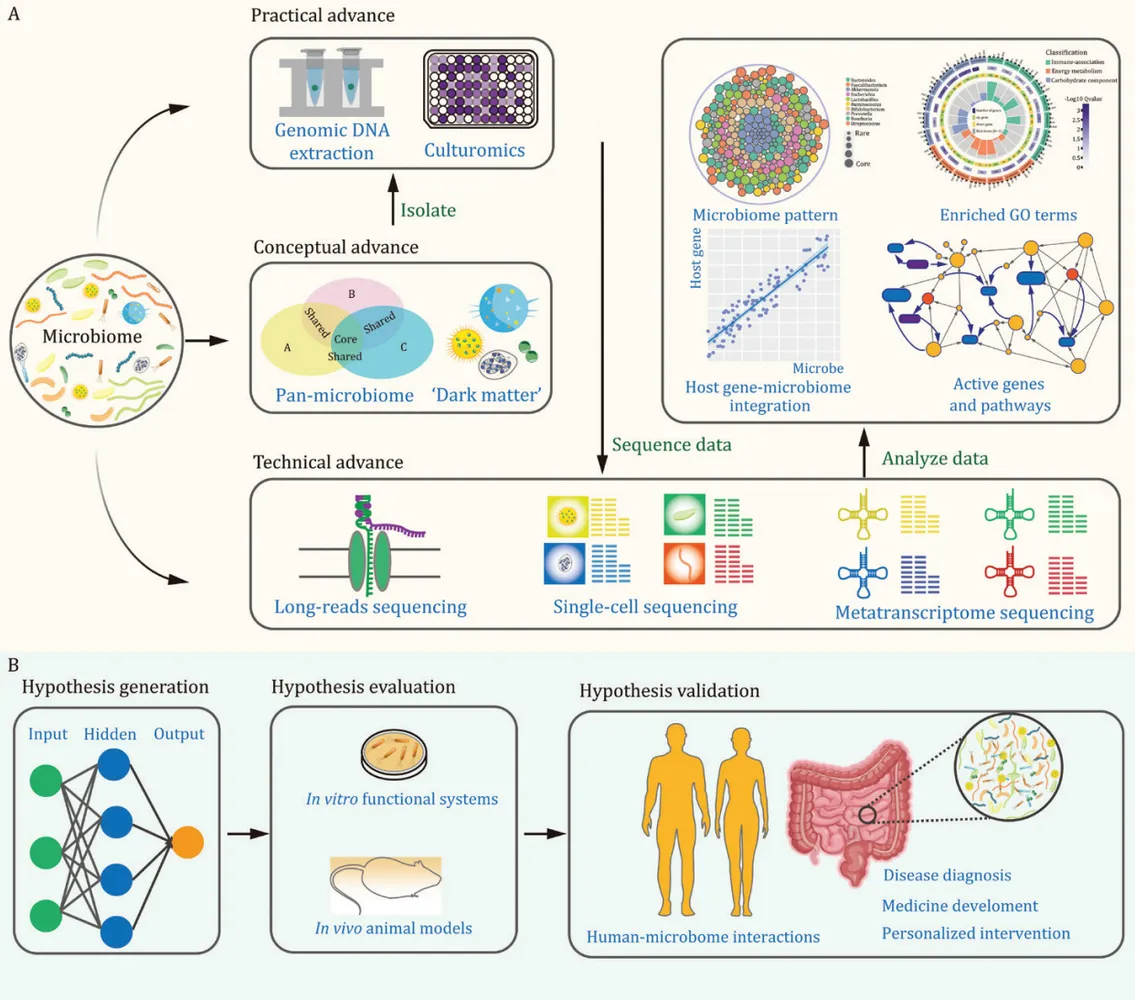
In the gut, microorganisims help ferment the dietary fiber we can’t digest on our own, turning it into useful short-chain fatty acids and other nutrients. They synthesize essential vitamins (like certain B vitamins and vitamin K) and amino acids. They break down toxins and drugs. They also form a living shield against infection, by crowding out or directly inhibiting harmful pathogens, our resident microorganisms provide something called colonization resistance that helps keep invaders at bay. In essence, the microbiota contributes to our basic bodily functions: digestion, metabolism, and immune defense, all in exchange for room and board in our bodies. […]
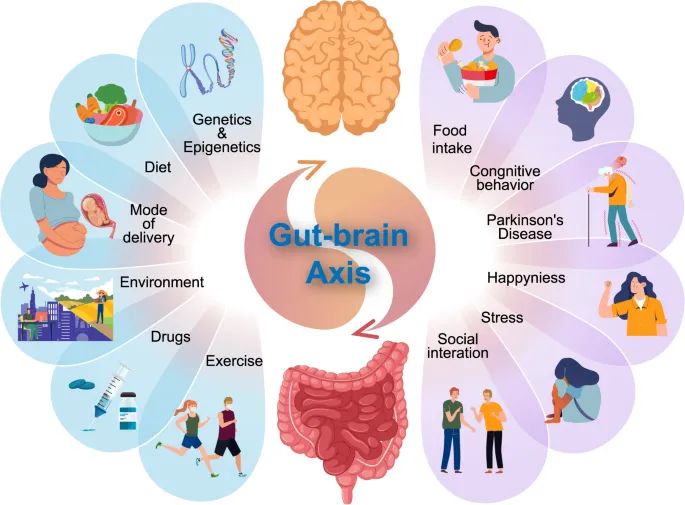
One of the most surprising frontiers in microbiota research is the discovery of the gut–brain axis – a communication superhighway between the intestinal microbiota and our nervous system. It sounds almost like science fiction:
How could gut bacteria possibly influence our mood, stress levels, or even behavior?
Yet mounting evidence shows they do, via a web of connections that link the gut and brain both physically and biochemically. Illustration of the gut–brain axis: The gut and brain communicate through neural pathways (like the vagus nerve), immune signals, and microbial metabolites. Multiple factors, from diet and stress to infections, can influence this two-way communication.
Given the microbiota’s deep involvement in so many bodily processes, it’s no surprise that disturbances in our microbial community – what scientists call dysbiosis – have been linked to a long list of diseases. Microbiota dysbiosis generally means an imbalance or maladaptation of the community: for example, a loss of beneficial organisms, a reduction in overall diversity, and/or an overgrowth of potentially harmful bacteria. This is a rather broad concept (some critics note “dysbiosis” can be a catch-all term without a precise definition), but it has been observed in conditions ranging from gastrointestinal disorders to metabolic and even neurologic diseases. […]
Hand in hand with the idea of dysbiosis is the concept of resilience - the ability of the microbiota to withstand disturbances or recover after one. Ecologists use this term for forests, oceans, and other ecosystems, and it applies to our internal ecosystem too. A resilient gut microbiota can take a hit (say, a week of antibiotics or a bout of gastroenteritis) and then return to a balanced state on its own, much like a forest regrows after a fire. In contrast, a non-resilient microbiota might shift into a new, altered state after a disturbance and struggle to revert to its prior equilibrium.
🪄Video Suggestion
Your Gut Microbiome: The Most Important Organ You’ve Never Heard Of by Erika Ebbel Angle
Market Perspective
The global human microbiome market is estimated at USD 1.20 billion in 2026 and is expected to reach USD 5.65 billion by 2033, growing at a CAGR of 24.8%. This growth is driven by rapid advancements in sequencing, growing startup activity, and rising demand for personalized medicine and synbiotics. Despite strong momentum, the sector still faces regulatory hurdles, high commercialization costs, and a critical lack of standardized endpoints and biomarkers, making it difficult to validate efficacy, compare trials, or gain consistent regulatory approval. This scientific ambiguity, paired with fragmented clinical definitions, positions the field as an opportunity-rich but complex space for early-stage biotech and VC exploration.
-Coherent Market Insights, Human Microbiome Market Report 2026-2033-
Startup Ecosystem
Microbiome startups are growing in Spain, Germany, the US and Australia, and the field has finally started to see its first regulatory approvals. Here are some examples:
A Basque Country based startup, founded in 2018, is pioneering industrial-scale development of microbiome-based medicines. Its lead therapy uses the complete, purified intestinal microbiota of screened healthy donors, freeze-dried into oral capsules and taken as a single dose of four capsules. This turns fecal microbiota transplantation, a field often criticized for lack of standardization, into a reproducible, drug-grade product made in its own GMP-certified facility. Its therapy has already shown efficacy and safety in a Phase III trial in Clostridioides difficile infection, where it was compared against an active antibiotic instead of placebo, and it has been given to more than 100 patients in Spanish public hospitals under a compassionate use program. It is also running a Phase II trial in recurrent diverticulitis and a Phase III trial in decompensated liver cirrhosis, and it aims to launch its therapy in Spain in 2026. It closed the first €1.6 million tranche of its Series A in March 2025 at a €10 million pre-money valuation, and later completed an equity crowdfunding campaign that brought in 271 private investors.
A Woburn, Massachusetts based company, founded in 2016 out of Caltech, targets the gut-brain axis to treat neurodegenerative diseases. Its approach is based on the idea that some brain diseases are driven by processes that start outside the brain, in the gut. Its lead candidate is a first-in-class oral small molecule for Parkinson’s disease that acts only in the gut, designed to delay the onset of the disease and slow its progression instead of only managing symptoms. After years of work on autism, the company rebranded in 2025 to focus fully on neurodegeneration. It raised a USD 20 million Series D in 2025, on top of more than USD 90 million raised in earlier rounds.
A Munich based startup, founded in 2020, develops live bacterial products to help cancer immunotherapies work better. Many patients don’t respond to checkpoint inhibitors, and the gut microbiome is one of the factors that seems to influence this. It uses a high-resolution microbiome profiling platform to identify which bacterial combinations are most likely to work, then builds a live bacterial product designed to improve the response to these drugs in advanced melanoma. It closed a €30 million Series A to take this product into a Phase 1b study in 2027.
An Adelaide based startup, founded in 2018, received the world’s first regulatory approval for a donor-derived microbiome therapy in 2022, when the Australian regulator approved its product for recurrent Clostridioides difficile infection. It now uses a platform that grows a human gut microbiome in a bioreactor, so it can select specific strains with disease-targeted functions and build “second-generation” cultured therapies, starting with ulcerative colitis. In April 2026, it secured a AUD 15 million investment from a leading Australian natural health company owned by Japan’s Kirin Holdings, to expand globally and develop probiotic products together.
If you are interested in the microbiome and would like to learn more about the startups mentioned here, or simply exchange ideas about this field, feel free to reach out to me. I’d be happy to share more details and help you find the right connections.
The information in this Market section was last updated in September 2026. Market figures, funding amounts and company details may have changed after this date.
🪄 Bonus Insight
The human microbiota is becoming the next variable in clinical trial design.
Pharma companies are now screening trial participants not just by genetics or biomarkers but by microbiome profile. Why? Because response to drugs (especially in oncology, immunology, and neurology) is increasingly linked to gut microbial composition.
Future Perspective
In the coming decade, the human microbiota will no longer be treated as a peripheral curiosity. It will become a central operating system in medicine, diagnostics, and personalized care.
We are moving from a model where treatments target organs and symptoms to one where we treat the host–ecosystem interface. This shift unlocks a new set of rules:
- Drugs will be developed with microbiome compatibility in mind, just like we now account for liver or kidney function.
- Clinical trials will start with microbial profiling to stratify responders vs. non-responders.
- Routine health assessments will include microbiota resilience scores, perhaps even tracked longitudinally like cholesterol or blood sugar.
But perhaps the most paradigm-shifting idea is this: microbiota won’t just be a biomarker, it will be an active participant in health optimization.
We may soon see insurance models that include microbiome maintenance plans. Public health efforts may target microbial diversity as a population-wide metric. Governments might one day regulate food not just by its macros, but by its impact on the human microbial landscape.
The future is not just personalized. It’s symbiotic.
🤨 Wait… you missed my last issue on Nanorobots in Healthcare
📰 SUBSCRIBE TO MY LINKEDIN NEWSLETTER
If you liked this newsletter article, I hope you’ll consider being a regular subscriber. 🙏
Just scroll up to the very top and click that SUBSCRIBE button.
Originally published on LinkedIn.