BioRevolution #14 - Quantum Biology
Sometimes, when researching certain topics, I’m so amazed that I need to take a break to process everything. This topic was one of those moments.
The concept of quantum alone is groundbreaking. I’m not even sure we fully grasp what quantum computers are capable of yet. But then, when you add biology into the mix… well, that’s when it truly becomes my favorite topic!
One of the most enjoyable parts of this work, in my opinion, is the realization that there are YouTube videos from 9-10 years ago on this topic. This means that scientists have been working on quantum biology for more than a decade, carefully developing and refining it before introducing it to the general public. If we want to create projects that catch up with the present moment, we must focus on the future because today’s projects are the result of years of development. These breakthroughs didn’t happen overnight, and as I always say, “It’s too late for today, but it’s the perfect time for tomorrow.”
I’m sure for many of you, this article will be your first encounter with quantum biology. I’ve made a conscious effort to explain it clearly and simply, and I believe I’ve succeeded. However, I must also point out an important cautionary note: Quantum biology is such a new field that some non-scientists are attempting to profit from it by exploiting this emerging concept. Be wary of these individuals. Stay with science. Now, let’s dive in and explore what quantum biology is all about!
Scientific Perspective
Quantum biology is a fascinating and relatively new field that explores the application of quantum mechanics—the science of the very small—to biological processes. At first glance, biology and quantum mechanics might seem worlds apart. After all, quantum mechanics deals with particles like electrons and photons, which behave in strange and often counterintuitive ways that don’t match the experience of our everyday lives. Biology, on the other hand, is concerned with the study of living organisms and the biochemical processes that sustain them. So, what happens when these two realms converge?
Quantum mechanics, the branch of physics that studies the behavior of matter and energy on the smallest scales, governs the microscopic world. At this level, particles don’t follow the straightforward laws of classical physics. Instead, they exhibit behaviors like superposition (being in multiple states at once), entanglement (where particles are mysteriously linked across vast distances), and tunneling (where particles pass through barriers they shouldn’t be able to).
But as researchers dug deeper, they began to notice that some biological phenomena seem to exhibit these very same quantum effects. This realization gave birth to the field of quantum biology, which aims to understand how quantum mechanics plays a role in processes like photosynthesis, enzyme reactions, and even the navigation of migratory birds.
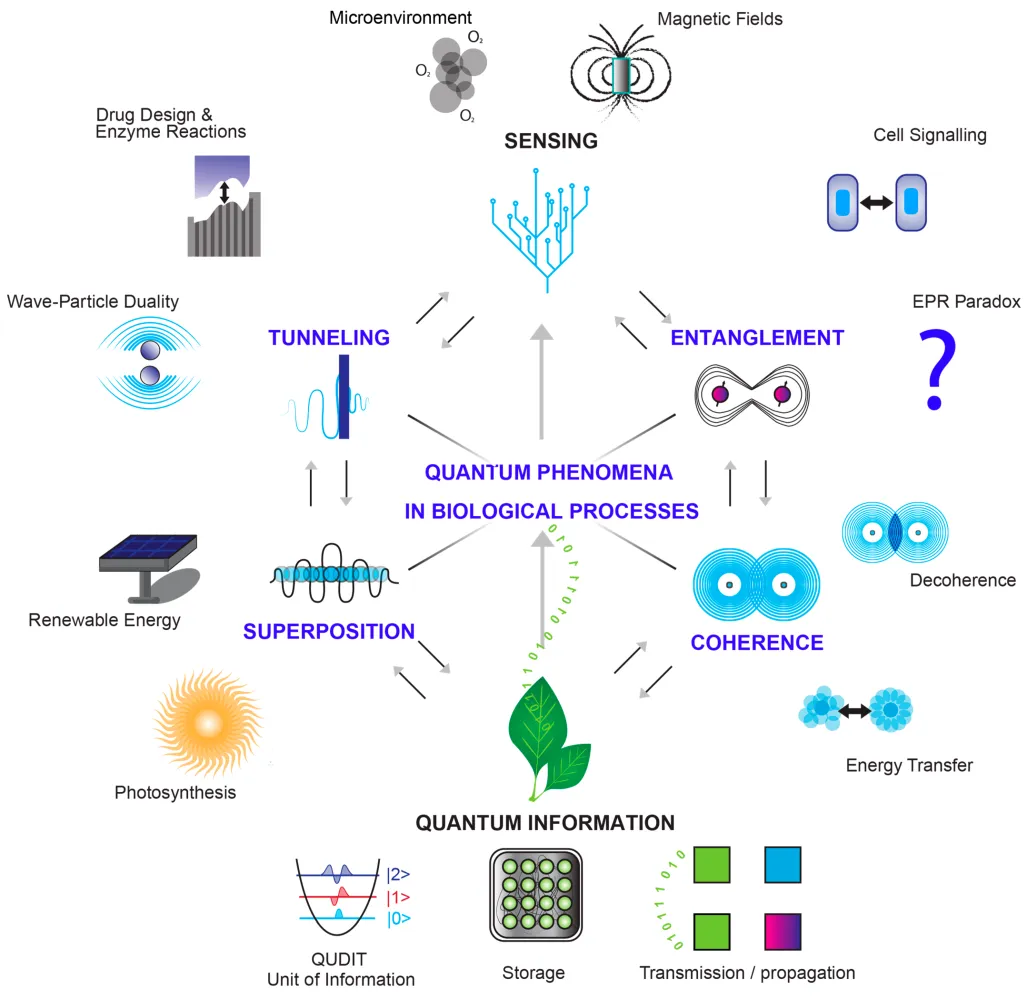
Key Concepts in Quantum Biology
- Quantum Superposition: In quantum mechanics, particles can exist in multiple states at once—an idea known as superposition. While this might sound like science fiction, this concept has been observed in biological systems. For example, in the process of photosynthesis, plants use quantum superposition to transfer energy more efficiently. Electrons in the plant’s chlorophyll molecules exist in a superposition of different energy states, allowing the plant to harness solar energy with incredible precision.
- Quantum Entanglement: This is a phenomenon where particles become linked, such that the state of one particle instantly affects the state of another, even if they are light-years apart. In biology, there is evidence suggesting that quantum entanglement may play a role in the navigation abilities of migratory birds. These birds are believed to use the Earth’s magnetic field to guide their long journeys, and quantum entanglement in a protein called cryptochrome is thought to help them sense the magnetic field, providing a potential quantum mechanism for their navigation.
- Quantum Tunneling: In quantum mechanics, particles can “tunnel” through energy barriers that, in classical physics, they would never be able to overcome. Some enzymes in the body use this property of quantum mechanics to speed up chemical reactions. This ability to tunnel through energy barriers allows the enzymes to break down molecules more efficiently, contributing to the metabolic processes that sustain life.
- Quantum Coherence: Coherence refers to the idea that particles remain in sync or “coherent” with each other over time. In quantum biology, coherence may help explain how certain biological processes—such as photosynthesis—operate with such extraordinary efficiency. The coherence of quantum states allows for energy to be transferred across biological systems in an organized manner, minimizing energy loss and maximizing efficiency.
🪄Video Suggestion
Quantum Biology: The Hidden Nature of Nature by World Science Festival (June 1, 2012)
Market Perspective
Quantum biology itself is still a young scientific field, and there is no reliable market data for it yet. But its closest commercial neighbor is growing fast: using quantum technologies to understand and design molecules for medicine. The global quantum computing in healthcare market was valued at USD 191 million in 2024 and reached USD 266 million in 2025. It is projected to reach USD 1.32 billion by 2030, growing at a CAGR of 37.9%. The main driver is the need for faster and more advanced data analysis in drug discovery, genomics and precision medicine.
-MarketsandMarkets, Quantum Computing in Healthcare Market Report 2025-2030-
Startup Ecosystem
Startups at the intersection of quantum physics and biology are growing in the US, Canada and Japan, often with strong support from national quantum programs. Here are some examples:
A Watertown, Massachusetts based startup, founded in 2022, designs small-molecule drugs using a physics-driven approach. Its platform simulates how molecules behave and interact with their protein targets based on the laws of physics, combined with artificial intelligence and supercomputing, so it can design drugs for protein targets that were previously considered too difficult. It focuses on immune and inflammatory diseases. In December 2025, it spun out from a larger biotech group under a new name and announced a USD 47.5 million Series A.
A Waterloo, Ontario based startup, spun out of the University of Waterloo, has built the world’s first commercially available quantum-enabled EPR spectrometer. Proteins constantly bend, twist and change shape, and many drugs fail because static methods can’t capture this motion. Its instrument replaces classical components with superconducting quantum sensors, so it can capture all the shapes a protein takes at the same time, acting like an atomic ruler at the nanoscale. It also automates the process, cutting experiments from weeks to hours without requiring in-house experts. In June 2026, supported by Canada’s National Quantum Strategy, it signed a global partnership with a structural biology CRO serving over 3,000 customers in 60 countries. One key focus is drug discovery for Alzheimer’s and other neurodegenerative diseases.
A Tokyo based startup, founded in 2018, develops algorithms and software that let quantum computers solve chemistry problems. Traditional computers struggle to model complex molecular interactions because the number of possible configurations grows too fast, and quantum computers are expected to handle this much better. Its tools are used for drug discovery, materials science and energy. It has raised around USD 29.7 million, with investors including IBM Ventures, Global Brain and Mitsubishi Electric. In 2025, it received a DKK 19 million grant from Innovation Fund Denmark for a four-year project with the University of Copenhagen and the Novo Nordisk Foundation’s quantum computing program.
If you are interested in quantum biology and would like to learn more about the startups mentioned here, or simply exchange ideas about this field, feel free to reach out to me. I’d be happy to share more details and help you find the right connections.
The information in this Market section was last updated in September 2026. Market figures, funding amounts and company details may have changed after this date.
🪄Video Suggestion
Presentation from The Renaissance of Quantum Biology by K. Birgitta Whaley (UC Berkeley), doi:10.26081/K6R60R, Jun 18, 2020, online from the Kavli Institute for Theoretical Physics (KITP).
Future Perspective
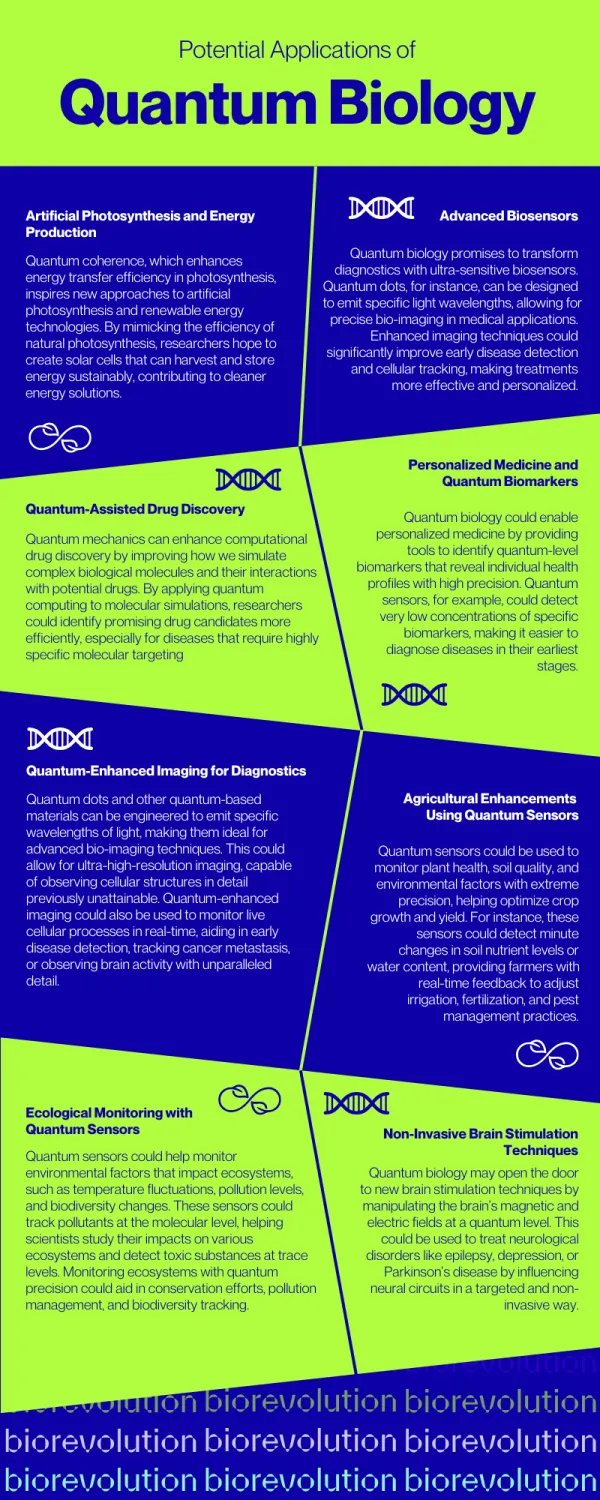
One of the most exciting implications of quantum biology is the potential for new technologies. For example, if we can harness the quantum mechanisms used by plants in photosynthesis, we might be able to develop ultra-efficient solar energy systems. Similarly, understanding how quantum effects enhance enzyme activity could lead to breakthroughs in medicine and biochemistry, potentially paving the way for the development of new drugs or more efficient industrial processes.
The frontier of quantum biology is still in its early stages, and there’s much we don’t yet understand about the role of quantum mechanics in living organisms. But the progress made in recent years has already begun to reshape our understanding of life itself. Quantum biology promises to bridge the gap between two of the most profound areas of science: the strange, mysterious world of quantum mechanics and the complex, awe-inspiring processes that make life possible.
As research continues, we can only imagine what discoveries lie ahead. Will we uncover even more quantum secrets hidden in nature’s processes? Will this understanding allow us to develop revolutionary technologies that change the world? Only time will tell, but one thing is certain—quantum biology is a field that holds vast potential for both scientific discovery and practical application.
📰 SUBSCRIBE TO MY LINKEDIN NEWSLETTER
If you liked this newsletter article, I hope you’ll consider being a regular subscriber. 🙏
Just scroll up to the very top and click that SUBSCRIBE button.
Originally published on LinkedIn.