BioRevolution #3 - Circular Bioeconomy
When we say biotechnology, biology, etc., we don’t usually think economy. I asked ChatGPT what is the economy, and it answered “Economy refers to the system by which goods and services are produced, distributed, and consumed within a society”. We produce, distribute, and consume bio-based products, plus we can do this circularly. Welcome to the world of the circular bioeconomy, an innovative economic model that stands as a beacon of hope in addressing pressing global challenges such as climate change, biodiversity loss, and social inequality.
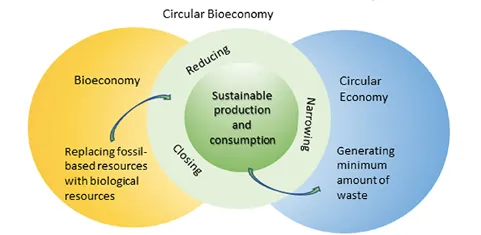
Circular Bioeconomy
At its core, the circular bioeconomy strives to ensure sustainable well-being by managing biological resources, including plants, animals, micro-organisms, and biomass, in a way that is both environmentally friendly and economically viable. This model relies on the stewardship of healthy, biodiverse ecosystems and presents a shift towards a climate- and nature-positive economy.
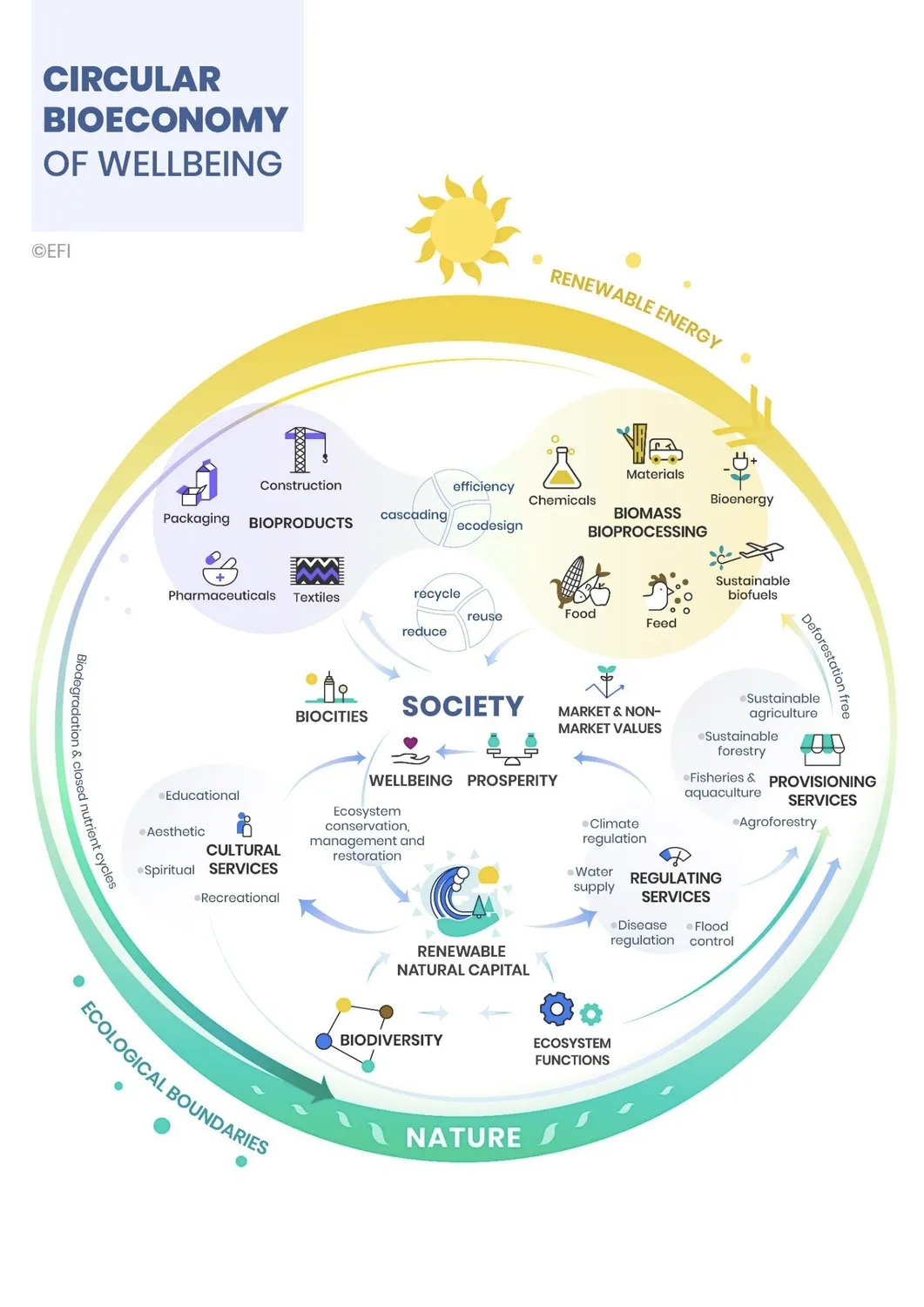
The potential economic impact of embracing a circular bioeconomy is staggering. Sustainable forest management alone can unlock $230 billion in business opportunities and generate 16 million jobs by 2030. Shifting energy and extractive systems towards circular and resource-efficient models could result in $2.3 trillion in business opportunities and 30 million jobs by the same year. Moreover, integrating nature into infrastructure and built environments may create $3 trillion in business opportunities and 117 million jobs by 2030. […]
Global Initiatives and Leadership
The Biden-Harris Administration has taken significant steps to advance biotechnology and biomanufacturing in the United States, emphasizing sustainability and security through the Executive Order on Advancing Biotechnology and Biomanufacturing Innovation. The National Biotechnology and Biomanufacturing Initiative was launched to advance American biotechnology and biomanufacturing in health, climate change, energy, food security, agriculture, supply chain resilience, and national and economic security. […]
Similarly, the European Commission has developed a comprehensive bioeconomy strategy with five key goals, ranging from ensuring food and nutrition security to strengthening European competitiveness and creating jobs. The action plan outlines 14 concrete steps to accelerate the deployment of a sustainable European bioeconomy.[…]
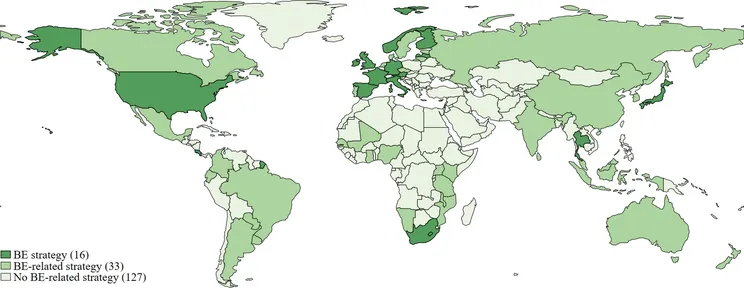
A review paper titled “Mapping 3R and Circular Economy Policy Implementation in Asia and the Pacific” highlights the varying degrees of circular economy policy implementation across the region. While some areas are making significant strides, others are in the early phases, with a common challenge being the lack of concrete policies addressing emerging waste. […]
Geographical coverage of coded bio-related policy documents
🚨Groundbreaking News: WBCSD – World Business Council for Sustainable Development highlights the potential of the circular bioeconomy. The report estimates that the circular bioeconomy presents a $7.7 trillion opportunity for businesses and is a key element in the fight against climate change, biodiversity loss, and resource scarcity. The report also features a dozen business case studies and a tool to help assess the sustainability performance and economic viability of new products.
Circular Bioeconomy in Practice
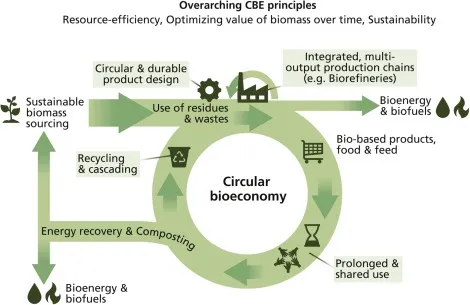
The circular bioeconomy integrates circular economy and bioeconomy principles to create a regenerative system where biological resources are efficiently utilized, waste is minimized, and the value of products and materials is prolonged. This approach underscores the sustainable use of resources, including agricultural waste biomass, and advocates for the reduction, recycling, and reuse of generated wastes and by-products.
Regenerate Natural Systems: This principle focuses on restoring and regenerating natural ecosystems to promote biodiversity and sustainability.
Biorefinery Models: The development of waste biorefinery models is a key aspect of circular bioeconomy principles. These models involve efficiently extracting value from biomass, including agricultural waste, through processes like bioconversion, fermentation, and other biotechnological methods.
Industrial Symbiosis: Circular bioeconomy promotes industrial symbiosis, where different industries collaborate to share resources and by-products, creating a synergistic relationship that reduces waste and enhances efficiency.
Clean, No-Waste Production: The concept of clean, no-waste production is crucial. It involves designing production processes that generate minimal waste and pollution, contributing to a more sustainable and environmentally friendly system.
🚨Groundbreaking News: World BioEconomy Forum (WCBEF) has observed traction in the bioeconomy landscape, including:
• An increased number of bioeconomy strategies. There are already close to 60 national bio strategies and several regional bio strategies.
• The value of the bioeconomy is increasing. Schmidt Futures reports it may be even $30 trillion by 2030. Countries like the USA have projected values for the bioeconomy; in some countries, the granularity is at the state level. The state of Para in Brazil estimates their bioeconomy value at $120 billion.
• There is also increasing discussion on product safety and acceptance, supply chains, traceability, feedstock availability, etc that would benefit discussion at the global level.
Market Perspective
The bioeconomy is one of the largest and fastest-changing economic areas in the world. The OECD estimates that the global bioeconomy was worth around USD 4-5 trillion in 2023 and projects that it could reach around USD 30 trillion by 2050. Europe has a strong share in this picture. The EU’s bioeconomy was worth up to EUR 2.7 trillion in 2023. That same year, biomass producing and converting activities employed 17.1 million people in the EU, 8% of all EU jobs, and generated EUR 863 billion in value added, 5% of EU GDP.
-European Commission, EU Bioeconomy Strategy (COM(2025) 960) / OECD, via StartUs Insights Synthetic Biology Market Report 2026-
Startup Ecosystem
Circular bioeconomy startups are growing especially in Western Europe (France and Germany), the US, and Australia, with production capacity increasingly moving towards Asia. Here are some examples:
A France based company, founded in 2011, designs enzymes that break down PET plastics and polyester textiles. Its engineered enzyme cuts PET back into its two original building blocks, terephthalic acid and ethylene glycol, which can then be turned into new PET with virgin-level quality. The company is now publicly listed. Its first industrial biorecycling plant in France will process 50,000 tonnes of prepared PET waste per year. The plant is expected to cost €230 million, and €42.5 million of public funding has already been secured for it. By summer 2026, most of the project’s lenders had approved the financing, and a deal with a major beverage company was being finalized that would bring pre-sales to 60% of the plant’s capacity. The company is also building a licensed industrial facility in China through a joint venture with a Chinese partner.
A Hamburg based startup, founded in 2020 as a university spin-off, turns agricultural residues into a plastic alternative. Its patented process extracts natural polymers such as cellulose, lignin and starch from agricultural by-products without changing their natural chemical structure. The resulting granules are bio-based, home-compostable and can be processed on standard industrial equipment. It raised a €36.6 million Series A to build its first industrial plant. That plant opened in 2026 with a capacity of around 3,000 tonnes per year, as part of an investment of more than €20 million that included €5.1 million in public funding.
An Australia based startup, founded in 2020 as a spin-off from the Australian National University, develops plastic-eating enzymes. It uses artificial intelligence to design enzymes that break textiles and packaging down into monomers, which can be used to make new plastics without any loss in quality. It has raised $106 million over 5 rounds. Its latest round of $65 million was led by Temasek, with a global sportswear brand and Hitachi Ventures among the backers. In 2026, it reportedly launched a $100 million Series B to use its enzyme platform for recovering rare earth metals from batteries, magnets and mine tailings.
A Houston based startup, founded in 2016, produces chemicals from plant sugars instead of oil. Its production platform combines enzymes with metal catalysts to make organic acids used in concrete, cleaning, agriculture and energy. It has raised $656 million across 8 rounds. Its latest disclosed valuation was $1 billion. In 2024 it received a $213.6 million conditional loan guarantee from the US Department of Energy for a new facility in Minnesota. It was the largest US government investment in bioindustrial manufacturing since the 2022 executive order on biomanufacturing.
If you are interested in the circular bioeconomy and would like to learn more about the startups mentioned here, or discover other promising teams in this space, feel free to reach out to me. I’d be happy to share more details and help you find the right connections.
The information in this Market section was last updated in September 2026. Market figures, funding amounts and company details may have changed after this date.
Future Perspective
-Photosynthesis serves as the foundation for circular bioeconomy. As we progress, we’re discovering more effective methods to transform sunlight into energy and products. This spans from innovative techniques like breeding & cultivating climate-resilient crops to processes such as biorefining and efficient biomass conversion. Efforts are also underway to enhance energy retention in soil. The agricultural sector is increasingly embracing regenerative farming, as emphasized by initiatives like the COP28 Action Agenda on Regenerative Landscapes. In biotechnology, precision fermentation emerges as a key solution for both food and specialty chemicals, addressing challenges in food security and sustainability. Moreover, the biomaterials sector is making strides in sustainable packaging, with notable progress in transforming paper into alternatives for plastics.
by Hakan Karan, PhD , ECBF VC
-Reducing food waste and recycling requires a lot of dedication, as well as innovative economic models and incentive systems, as well as coordination and communication between many stakeholders. Achieving circularity requires strong governmental interventions that put sustainable technologies into reality and offer reliable and strong incentive systems. With more than 60 million tons of wasted food exported annually—less than thirty percent of which are recovered in any value retention pathway—the United States ranks third in the world for food waste exports. Research is obviously needed to help shape US policy that will support CE solutions for waste food management at the formulation and execution stages.
by Michael Remon Abdelmalk , MU Group
See you beyond circular bioeconomy :)
📰 SUBSCRIBE TO MY LINKEDIN NEWSLETTER
If you liked this newsletter article, I hope you’ll consider being a regular subscriber. 🙏
Just scroll up to the very top and click that SUBSCRIBE button.
Originally published on LinkedIn.