BioRevolution #2 - Biotechnology Trends in 2034
You didn’t read wrong, I didn’t write wrong. Our topic is “Biotechnology Trends in 2034”. When I was scrolling through social media platforms, I saw a lot of trend reports about 2024. If you are a developer, scientist, or investor and you want to catch 2024 trends, you should have started to work nearly 10 years ago. These reports say what users will see as products this year, but if you want to be a game changer, 2024 trends are too late for you. Come to the right time, 2034.
We will examine it under 5 main subheadings;
- Navigating the Future: Become a Game Changer in the Biotech Ecosystem
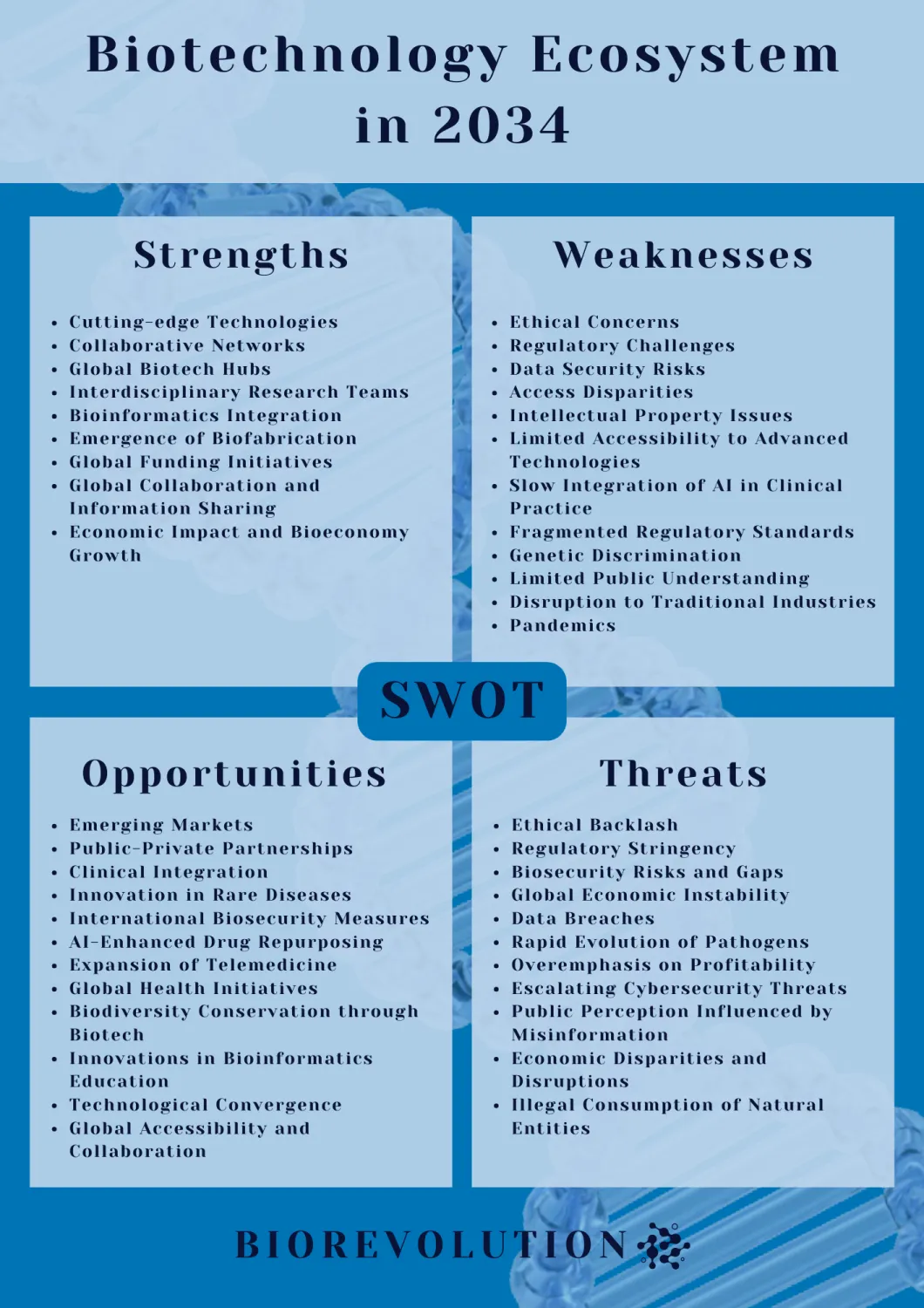
- Preparing for the Unknown: Swot Analysis of the Biotech Ecosystem in 2034
- Expanding the Horizons: Beyond 2034
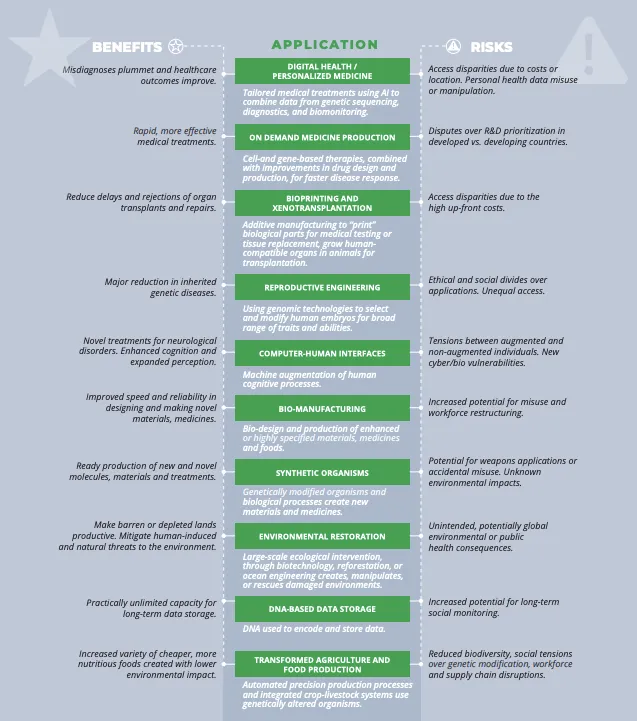
- Benefits and Risks of Advanced Biotechnology Applications
- Beyond Rivalry: The Coopetitive Revolution Transforming Biotech in 2034
Navigating the Future: Become a Game Changer in the Biotech Ecosystem
The world of biotechnology stands on the cusp of transformative innovation, poised to reshape industries and redefine the boundaries of scientific discovery. As we look ahead to 2034, the biotech landscape promises to be a dynamic tapestry woven with breakthroughs, challenges, and collaborative endeavors.
1. Rapid Innovation in Biotechnology
Biotechnology is rapidly advancing due to progress in manipulating living things, automation, information sciences, and materials sciences. Scientists expect many exciting discoveries that will greatly impact health, agriculture, manufacturing, and cognitive sciences. The ability to control biological systems is leading to groundbreaking findings that go beyond what we can currently imagine.
2. Building Bridges Across Borders
The power of collaboration is at the heart of biotech’s revolution. Collaborative networks, spanning research institutes, governmental agencies, NGOs, and private corporations, are becoming the crucibles of innovation. In 2034, the interconnectedness of these networks is expected to catalyze the pace of discovery, providing a platform for the exchange of knowledge and ideas on a global scale.
3. Shaping Global Economies
Biotechnology is not merely a scientific endeavor; it’s a driving force in the global economy. Forecasts suggest that by 2040, biotech could influence up to 20% of global economic activity. Growth rates in the bioeconomy, particularly in agriculture and manufacturing, are poised to reshape industries and contribute significantly to the economic landscape.
4. Navigating the Frontiers of Innovation
The transformative nature of biotech, especially in areas like genetically modified crops and foods, raises critical regulatory and ethical considerations. Finding a balance between new ideas and safety, and making sure we do things ethically, is very important for keeping people’s trust and making sure people like what we’re doing. Doing things in a way that takes care of the environment and helps society means that we’re making progress in ways that are good for everyone.
5. The Confluence of Technological Forces
Technological convergence is becoming a great opportunity. The combination of AI, high-speed telecommunications, and biotechnology is unlocking new possibilities. This fusion is not only meeting societal needs but also creating new markets and lowering barriers to global accessibility, even in developing countries.
6. Economic Disparities and Disruptions
The speed at which technology is changing, especially in advanced manufacturing, AI, and biotechnology, might make traditional industries and global supply chains be disrupted faster. Even though new chances will come up, workforce retraining and addressing economic disparities will be essential to ensure an inclusive and equitable transition.
Preparing for the Unknown: Swot Analysis of the Biotech Ecosystem in 2034
Expanding the Horizons: Beyond 2034
As we peer into the future of biotechnology in 2034, new horizons emerge with technologies that push the boundaries of what we thought possible.
1. Brain Mapping: Unlocking the Secrets of the Mind
Google and Harvard have embarked on an extraordinary journey – mapping the equivalent of a 1-millionth section of the human brain. […] As technology advances, enabling the mapping of larger areas, we anticipate a profound understanding of the brain. This breakthrough promises to aid those with traumatic injuries or neurological disorders, marking a pivotal advancement in healthcare.
2. Autonomous Therapeutic Systems: Empowering Patient-Centric Care
Autonomous therapeutic systems are poised to revolutionize patient care. These systems, driven by analyzing and autonomously controlling conditions and treatments, require a precise simulation of a patient’s medical condition—the patient’s bio-digital twin. This not only reduces human error but holds the potential to significantly lower medical care costs, marking a paradigm shift in healthcare delivery.
3. Biotechnology in Addressing Global Challenges: Shaping a Sustainable Future
The use of biotechnology to solve global challenges in food security and environmental sustainability is expected to be a major trend in 2034. Biotech crops that produce more food, require less pesticides and cause less harm to the environment will help meet the world’s future needs for food and environmental security.
4. Biotechnological Literacy
The role of education and public perception in shaping the trajectory of biotechnology cannot be understated. Preparing the next generation requires future educators to have a good understanding of biotechnology and incorporate biotechnological knowledge into their teaching.
5. Microbial Biotechnological Approaches in Energy Systems: Shaping Future Energy Landscapes
In the context of energy systems, microbial biotechnological approaches are anticipated to play a crucial role in shaping future energy landscapes. With the world facing an energy crisis, bioprocessing utilizing microbial biotechnological approaches is positioned as a renewable solution for future energy systems.
6. Urban Biotechnology: Addressing Urbanization and Habitat Management
The rise of “urban biotechnology” shows that biotechnology can help with the problems caused by urbanization and habitat management. This innovative approach holds promise for creating sustainable and efficient urban ecosystems.
7. Tackling Aging with Biotechnology: Prolonging Health and Wellness
By 2034, projections indicate a substantial portion of the global population will be aged 65 and above, presenting unprecedented challenges for healthcare systems, social structures, and economies. The world is witnessing a surge in life expectancy, bringing with it the challenges and opportunities associated with an aging population. It is within this context that biotechnology emerges as a key player that lies not just in adding years to life but in adding life to years, presenting a transformative trajectory for the aging process and the societal structures that surround it in reshaping the narrative of aging.
Benefits and Risks of Advanced Biotechnology Applications
Beyond Rivalry: The Coopetitive Revolution Transforming Biotech in 2034
Explore the revolution underway in the biotech sector, where companies are rewriting the rules of engagement, choosing collaboration as a catalyst for transformative advancements and global impact.
Coopetition, a portmanteau of “cooperation” and “competition,” refers to a strategic business concept where companies engage in both cooperative and competitive actions simultaneously. In a coopetitive relationship, organizations collaborate on certain aspects of their operations while also competing in other areas. This approach acknowledges that in certain contexts, competitors can benefit from working together, even as they compete in other facets of their business.
Now, considering the biotech ecosystem in 2034, coopetition is likely to play a crucial role in shaping the industry. Here’s what it might mean:
- Accelerated Innovation through Collaboration
- Resource Optimization
- Access to Complementary Expertise
- Navigating Regulatory Challenges
- Market Access and Distribution
- Risk Mitigation
- Global Problem Solving
- Technological Convergence
In summary, in the biotech ecosystem of 2034, coopetition is likely to be a strategic imperative, enabling companies to navigate the complexities of the industry, accelerate innovation, and collectively address global challenges. It represents a nuanced approach where cooperation and competition coexist for the benefit of industry players and, ultimately, society.
We will be together again in two weeks with our new topic, Circular Bioeconomy.
See you beyond 2034:)
📰 SUBSCRIBE TO MY LINKEDIN NEWSLETTER
If you liked this newsletter article, I hope you’ll consider being a regular subscriber. 🙏
Just scroll up to the very top and click that SUBSCRIBE button.
Originally published on LinkedIn.